
Aintree Racecourse Guide: Fences, Courses and What to Expect
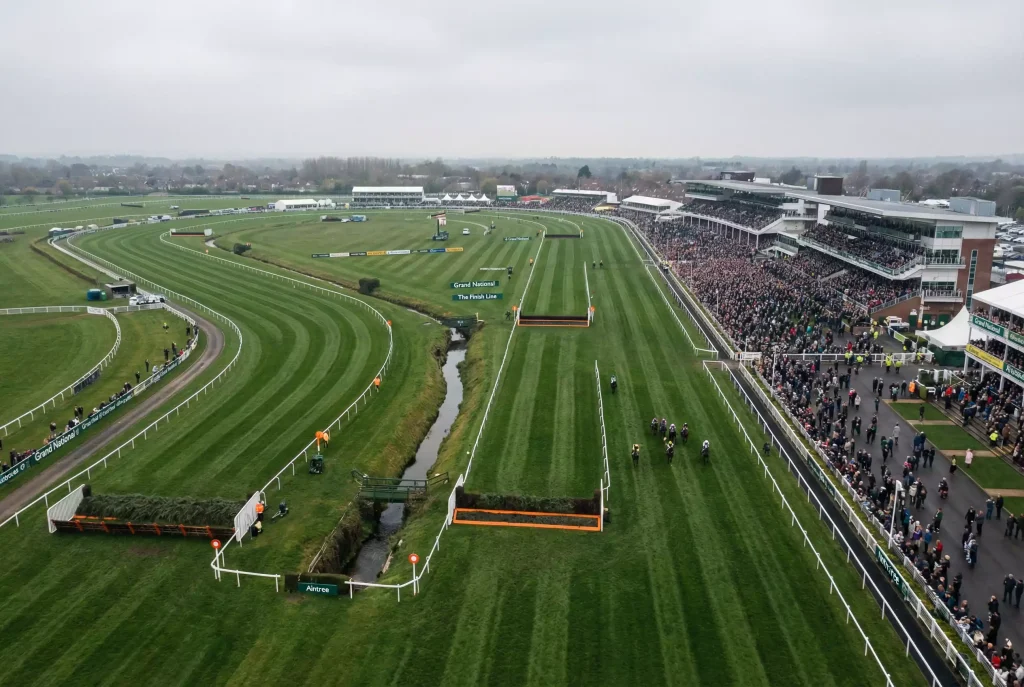
Aintree racecourse is unlike any other venue in British horse racing. Situated on the northern edge of Liverpool, it hosts the world’s most famous steeplechase over obstacles that exist nowhere else on the racing calendar. The fences here have names that resonate far beyond racing circles: Becher’s Brook, The Chair, Canal Turn. These are not marketing inventions. They are genuine tests of horse and jockey that have shaped the Grand National’s mythology since 1839.
What many casual punters do not realise is that Aintree operates two distinct courses. The Grand National Course—the outer circuit with its 30 unique fences—runs only a handful of times each year. The Mildmay Course—a tighter inner track with conventional obstacles—hosts the majority of racing during the Festival and throughout the season. Understanding which course a race uses, and what that course demands, is fundamental to making informed bets.
The two courses attract different types of horses. Galloping stayers thrive on the National Course; handy, nimble types prefer the Mildmay. A horse who dominates the Melling Chase—run over the Mildmay at two miles—may have entirely wrong attributes for the Grand National. Conversely, a Becher Chase winner has proven aptitude for the unique fences but tells you nothing about Mildmay suitability.
This guide walks through both circuits in detail. You will learn the dimensions and characteristics of the Grand National Course, the specific challenges posed by each famous fence, and how the Mildmay Course differs in its demands. More practically, you will understand how course form—previous performance at Aintree specifically—should factor into your selections. Not every good jumper handles Aintree. Knowing which horses have proven they can is half the battle.
Where legends are made, details matter.
The Grand National Course
The Grand National Course measures four miles, two furlongs, and 74 yards—the longest distance in British racing’s top-tier calendar. It is run left-handed over two full circuits, with horses jumping 30 fences in total. Sixteen of those fences are unique; the remaining 14 are the same obstacles jumped a second time on the final circuit.
The terrain is largely flat, which might seem to favour front-runners. In practice, the distance and the jumping demands create a war of attrition. Horses who blaze early tend to empty before the Elbow—the sharp left turn into the home straight. The winners are typically those who travel economically, conserve energy over the first circuit, and have enough left to quicken when the race unfolds in earnest after the second Becher’s Brook.
Field Size and Safety Changes
From 2026, the Grand National field was reduced from 40 runners to 34. This change, implemented by the British Horseracing Authority, aimed to reduce congestion at the early fences and improve safety outcomes. The first fence and the tightly bunched early stages had historically been where fallers cluster, with loose horses compounding the chaos.
The smaller field has subtle betting implications. Fewer runners mean each horse carries a marginally higher win probability. It also means less value at extreme odds—a 100/1 shot in a 40-runner race implied roughly 1% chance; in a 34-runner race, the same implied probability would price closer to 80/1. The maths shifts slightly toward the market principals.
The Two-Circuit Structure
The Grand National’s two-circuit format creates distinct phases. The first circuit—fences 1-16—is where the field thins. Horses who struggle at Becher’s Brook or The Chair rarely get a second chance. Those who survive the first circuit face the same fences again, but with fatigue accumulating and the field more strung out.
By the time the surviving runners approach Becher’s Brook for the second time (fence 22), the race has taken shape. The leaders are visible, the stragglers are detached, and the decisive moves begin. The final four fences—23 through to 30—and the 494-yard run-in separate contenders from the rest. More Grand Nationals are won and lost on that final run-in than at any individual fence.
For bettors, this structure rewards horses with proven stamina over extreme distances. A horse who has won over three miles and five furlongs is more relevant than one who has won over two miles. The Grand National is not a speed test. It is an endurance event with obstacles.
The Famous Fences
Not all Grand National fences are created equal. While every obstacle presents a challenge, four fences carry reputations that define the race. Understanding what makes them difficult—and how horses typically handle them—adds depth to your analysis.
Becher’s Brook: Fences 6 and 22
Becher’s Brook is the most famous fence in steeplechasing. Named after Captain Martin Becher, who fell there in the inaugural 1839 Grand National, it combines a regulation-height fence with a landing side that drops away sharply. Horses jumping Becher’s must adjust mid-air for a landing approximately six inches lower than takeoff.
The drop has been modified over the decades. The landing area was levelled and the ground softened to reduce the jarring impact. Modern Becher’s Brook is less severe than its historical reputation suggests, but it remains a test of a horse’s adaptability. Those who have jumped it successfully before tend to remember the technique. First-timers often peck on landing or lose momentum.
Becher’s claims fewer fallers than it once did, but it still separates horses who handle the unexpected from those who do not. Course form at Aintree—whether from the Grand National, the Topham, or the Becher Chase—matters precisely because horses learn these fences.
The Chair: Fence 15
The Chair is the tallest and widest fence on the course. At five feet two inches high and spanning six feet in width, it demands maximum respect. The fence is approached after a long run from the previous obstacle, giving horses time to see its imposing dimensions. Some hesitate. The good jumpers attack it.
Unusually, The Chair is jumped only once, on the first circuit. By the second circuit, runners bypass it via the inside track. This makes it a pivotal moment—mistakes here happen early enough that fancied horses can be eliminated before the race truly develops.
The open ditch in front of The Chair adds complexity. Horses must judge both the ditch and the fence simultaneously, measuring their stride to clear the gap and still have enough height to brush through the spruce. It rewards bold, accurate jumpers and punishes the tentative.
Canal Turn: Fences 8 and 24
Canal Turn presents a different challenge: a 90-degree left turn immediately after landing. Horses jumping straight have no issue clearing the fence itself, but those who drift right on landing run out of room. The turn requires riders to angle their approach, which compromises the horse’s view of the fence.
Experienced Aintree horses handle Canal Turn instinctively. First-timers sometimes land wide, losing lengths and position. In a bunched field, the Turn can cause pile-ups as horses squeeze left simultaneously. The 2026 field reduction helped ease congestion here.
Foinavon: Fence 7 and 23
Foinavon is an unremarkable fence in isolation—one of the smaller obstacles on the course. Its fame derives entirely from the 1967 Grand National, when a loose horse caused a melee that brought down or stopped almost the entire field. The 100/1 outsider Foinavon, so far behind that his jockey had time to navigate the chaos, picked his way through and won by 15 lengths.
Since that day, the fence has borne his name. Modern Grand Nationals rarely see anything comparable—the improved safety protocols and smaller fields have reduced pile-up risks—but Foinavon remains a reminder that in this race, position and luck matter as much as ability.
Safety Context
The Grand National’s welfare record has improved significantly over the past decade. According to available data, the last ten Grand Nationals have seen five equine fatalities from 381 starters—a rate that, while not zero, represents substantial improvement over earlier eras. Notably, the period from 2013 to 2018 saw six consecutive Grand Nationals without a single equine fatality—a streak that demonstrated fence modifications were having their intended effect. Changes to Becher’s Brook, The Chair, and other obstacles reduced the severity of falls without eliminating the challenge entirely.
The 2026 field reduction from 40 to 34 runners represented the most significant structural change in years. Fewer horses at the first fence means less congestion; less congestion means fewer brought-down fallers. The early fences—particularly the first three—had historically seen the highest concentration of incidents, as tightly bunched fields jostle for position. A smaller field spreads the runners and reduces that risk.
None of this makes the Grand National safe in absolute terms. It remains the most demanding test in National Hunt racing, and the potential for serious incidents persists. But the trend is clear: the race has become progressively less hazardous without losing its essential character. The fences remain testing, the distance remains extreme, and the challenge remains worthy of the world’s most famous steeplechase.
The Mildmay Course
The Mildmay Course runs inside the Grand National circuit as a separate track with its own character. Named after Anthony Mildmay, a legendary amateur jockey who twice came agonisingly close to Grand National victory, it hosts the Festival’s non-National races and most of Aintree’s regular fixtures throughout the season.
At approximately one mile and five furlongs for the hurdle course, and varying distances for chases, the Mildmay is a conventional National Hunt track. Its fences are standard regulation obstacles—testing but not extreme. The turns are tighter than the National course, favouring handier horses over galloping types who need room to stretch out.
Key Races on the Mildmay
Three Grade 1 races headline the Mildmay card during the Festival. The Aintree Hurdle, run on Thursday, is the premier two-mile hurdle outside Cheltenham. Champion Hurdle runners frequently reappear here, often at more generous odds than they carried at Prestbury Park. The Melling Chase on Friday covers two miles for the fastest chasers in training—a speed test pure and simple, where slick jumping wins races. The Bowl, run on Saturday before the Grand National, tests three-mile chasers on a flat, galloping track and often features Cheltenham Gold Cup contenders seeking Festival consolation.
Each of these races demands different qualities. The Melling favours speed and slick jumping; the Bowl rewards stamina and tactical nous; the Aintree Hurdle often goes to progressive second-season hurdlers who have improved since the Cheltenham Festival. Lumping them together as “Mildmay races” misses the nuance. A Melling winner is a specialist two-miler; a Bowl winner is an out-and-out stayer. The form tells different stories.
Why the Distinction Matters for Bettors
Form on the Mildmay Course does not translate directly to Grand National Course performance. A horse who wins the Bowl—impressive as that is—has not proven it can handle Becher’s Brook or The Chair. The Mildmay fences are conventional obstacles; the National fences are something else entirely. Conversely, a Topham winner has jumped the National fences, just over a shorter trip.
When assessing Grand National contenders, prioritise form over the National fences specifically. The Becher Chase, run in December over the same obstacles, provides the clearest evidence. Topham form—the Friday handicap over two miles five furlongs of the National course—is also highly relevant. Mildmay form tells you a horse handles Aintree’s atmosphere, ground, and general demands, but not its unique obstacles. That distinction is critical.
Understanding the Layout
Aintree’s geography is deceptively simple. The Grand National Course forms a large outer oval, running left-handed. The Mildmay Course sits inside it, sharing the home straight but diverging for its own circuit. Both courses use the same grandstand and facilities—spectators simply watch different tracks depending on the race.
The Grand National Course begins in front of the stands, runs away from the crowds toward the first fence, then loops around the far side of the track before returning. The Canal Turn and Valentine’s Brook occupy the far end, invisible from the main enclosures. Television coverage fills that gap, but racegoers only see the horses emerge from the country section after fence 14.
The Chair, jumped once on the first circuit, stands alone in front of the grandstand—the only fence where spectators get an unobstructed view of horses tackling a major obstacle. The Water Jump follows shortly after, then runners bypass both on the second circuit, taking an inner route toward the Melling Road crossing and the final fences.
For betting purposes, the layout matters because it creates phases. The far side is where early carnage occurs, out of sight of most punters. The home straight is where races are decided, in full view. Horses who travel well through the far-side fences and emerge well-positioned at the 15th tend to be the ones fighting out the finish.
How the Course Shapes Your Betting
Aintree’s unique characteristics should influence how you assess Grand National contenders. Three factors matter most: jumping ability, stamina credentials, and proven course form.
Jumping Ability
The National fences are bigger, stiffer, and more demanding than standard chase obstacles. A horse who is a sloppy jumper at Cheltenham or Newbury will be an even sloppier jumper at Aintree, where mistakes are punished more severely. Look for horses with clean jumping records—few or no falls in recent runs—and ideally horses who have demonstrated they can handle drops and angles.
Previous Aintree experience is the best evidence. Horses who have completed the Topham, the Becher Chase, or a previous Grand National without major jumping errors have proven competence. First-time National runners are not automatically disqualified, but they carry more uncertainty. The learning curve at Aintree is steep; some horses adapt instantly, others never figure it out.
Jockey experience matters here too. Riders who know the course—who have walked it, who have jumped these fences dozens of times—bring valuable expertise. They know where to position their horse at Becher’s Brook, when to take the inside line at Canal Turn, how to measure the approach to The Chair. A good pilot can compensate for a horse’s inexperience; a nervous one can compound it.
Stamina for the Distance
Four miles two furlongs is an extreme test. Horses who have won beyond three miles—ideally three and a half miles or further—are more likely to see out the trip. Horses stepping up from two-mile-five-furlong handicaps face a significant jump in distance, and many fail to last home.
The run-in at Aintree is 494 yards—nearly three furlongs of flat running after the final fence. Horses who win their races from the front often get caught here. Those who travel strongly and quicken late tend to thrive. Assess how your selection finishes its races: do they pick up, or do they idle? A horse who stops in the last furlong of a three-mile chase will stop twice as hard in a four-mile race.
Breeding offers clues. Horses by proven stamina sires—deep pedigrees with staying blood on both sides—tend to handle the trip better than those bred for speed. It is not a guarantee, but it is a signal worth noting when comparing otherwise similar contenders.
Ground Conditions
Aintree typically rides good to soft during the April Festival, though conditions vary year to year. Horses with a strong preference for heavy ground may struggle if the track dries out; those who need faster going may find soft conditions draining. Check the going preferences of your selections and match them to the forecast.
Going affects stamina demands. Softer ground makes the trip more demanding; faster ground favours speed. If you are backing a horse on the edge of staying, firm ground helps. If your selection is a thorough stayer, soft ground will not inconvenience it. The going interacts with weight too—a horse carrying top weight on soft ground faces a doubly demanding test.
Course Form as a Filter
When in doubt, back course form. A horse who has run well at Aintree before—especially over the National fences—has demonstrated it handles the track. Horses with no Aintree experience are rolling dice. They might love it; they might hate it. Course winners remove that uncertainty.
This principle extends beyond just the Grand National. A horse who has won the Becher Chase, even against weaker opposition, has jumped these fences in race conditions and succeeded. A horse who ran well in the Topham, finishing in the first five over the National obstacles, has proven something. Form from the Mildmay Course is useful but less directly applicable—it tells you the horse handles Aintree, not that it handles Aintree’s unique challenges.
Getting to Aintree
Aintree sits in Merseyside, approximately five miles north of Liverpool city centre. The racecourse benefits from strong transport links, though Grand National weekend inevitably strains capacity. Planning ahead is not optional—it is essential.
By Rail
Aintree has its own railway station on the Merseyrail Ormskirk line, a short walk from the course entrance. Trains run from Liverpool Central and Sandhills, with services increased during the Festival. From Liverpool Lime Street—the mainline station for arrivals from London, Manchester, and elsewhere—transfer to Merseyrail via Liverpool Central.
On Grand National day, expect packed trains and platform queues. Arriving early and leaving late avoids the worst congestion. Some racegoers walk back to Sandhills after racing to bypass the Aintree station crush.
By Road
The racecourse is accessible via the M57 and M58 motorways, with signposted routes from both. Official car parks fill quickly; advance booking is recommended. Unofficial parking in surrounding streets attracts residents-only restrictions and traffic wardens on patrol. Budget time for delays—traffic around the course moves slowly before and after racing.
The Liverpool Connection
Aintree’s relationship with Liverpool extends beyond geography. The city embraces the Festival as a flagship event, with hotels, restaurants, and bars running Grand National specials throughout the week. According to OLBG data, the Aintree Festival attracted 513,305 visitors across 2022 to 2026, averaging 42,775 per raceday—a footprint that reverberates through the regional economy.
“This event does not really exist without the Liverpool people,” Dickon White, Regional Director for The Jockey Club’s North West region, has observed. “But it is also about all the local businesses that support us as well.” That symbiosis is visible during Festival week, when the city fills with racegoers and the course fills with Liverpudlians. Aintree belongs to its region in a way few British racecourses can claim. The atmosphere reflects it—this is not the hushed reverence of Ascot or the rural gentility of Cheltenham. Aintree is loud, proud, and distinctly Scouse.