Aintree Festival Betting: Thursday to Saturday Race-by-Race Guide
The Aintree Festival is more than the Grand National. Three days of racing, 21 races across Thursday through Saturday, multiple Grade 1 contests, and betting opportunities that extend far beyond the big race. If you focus only on Saturday’s main event, you miss the majority of what the Festival offers.
The numbers confirm the scale. According to OLBG attendance data, the Aintree Festival attracted 513,305 visitors across 2022 to 2026, averaging 42,775 racegoers per day. That footfall reflects a meeting with genuine depth—not a one-race carnival but a proper Festival where serious racing fans and casual punters alike find value across the card.
Thursday opens proceedings with the Aintree Hurdle, one of the best two-mile hurdle races outside Cheltenham. Friday—Ladies Day—features the Melling Chase for speed chasers and the Topham Chase over the Grand National fences. Saturday builds toward the National itself with the Bowl Chase, a three-mile Grade 1 that often attracts Cheltenham Gold Cup runners seeking redemption.
This guide breaks down each day of the Festival, highlighting the key races, the betting angles worth considering, and the trends that data reveals. Whether you bet across all three days or concentrate your stakes on specific targets, understanding the Festival’s structure helps you make better decisions.
Beyond the National, there is plenty more to play for.
Thursday: Opening Day
Thursday sets the tone for the Festival. Seven races across the afternoon, headlined by the Aintree Hurdle—a Grade 1 contest over two miles that regularly produces one of the best hurdling performances of the season. This is the day the serious racing begins, before the crowds peak on Friday and Saturday.
The Aintree Hurdle
The Aintree Hurdle occupies a unique position in the calendar. Run over two miles on good or good-to-soft ground at a flat, galloping track, it suits fast-travelling hurdlers who can sustain a high cruising speed. The race often attracts runners from the Champion Hurdle at Cheltenham three weeks earlier—horses either seeking a second top-level win of the spring or looking to bounce back from disappointing Festival runs.
For bettors, the key question is whether Cheltenham form translates. Sometimes it does: a horse beaten at Cheltenham on unsuitable ground finds Aintree’s flatter surface more to its liking. Sometimes it does not: the quick turnaround catches out horses who left everything at Prestbury Park. Studying how individual runners handle back-to-back targets—and how their trainers manage recovery—provides an edge.
Willie Mullins has dominated recent renewals, as he dominates most things in jump racing. His 2026 Aintree campaign yielded eight winners across the Festival, and he became the first Irish trainer to win the British National Hunt Trainers’ Championship in 70 years—a title not held by an Irish trainer since Vincent O’Brien in 1954. When Mullins runs multiple horses in the Aintree Hurdle, at least one typically goes close.
“I Am Maximus is very good. Paul got down off him with a big smile on his face yesterday morning, so that means he’s back to where Paul wants him anyway,” Mullins observed ahead of the 2026 Grand National, demonstrating the attention to detail that characterises his operation. That same meticulousness applies to his hurdlers on Thursday.
Supporting Races
Thursday’s undercard includes competitive handicaps that often produce value. The fields are typically smaller than Saturday’s cavalry charges, making form analysis more reliable. Bookmakers sometimes price Thursday races generously because public attention has not yet reached its peak.
The novice hurdles and handicap chases on Thursday reward punters who have done their homework. These are not lottery races. Horses that ran well at the Cheltenham Festival in their respective grades often reappear here, and their form is fresh enough to remain relevant. Cross-referencing Thursday entries with Cheltenham performances three weeks earlier provides a solid foundation for selections.
Look for horses with previous Aintree experience—the Mildmay Course has its own characteristics, and course form matters. Thursday’s lower profile means less money in the market, which can produce value spots. Prices on second and third favourites often drift longer than they should. Contrarian plays on unexposed horses can pay off when public attention is elsewhere.
Friday: Ladies Day
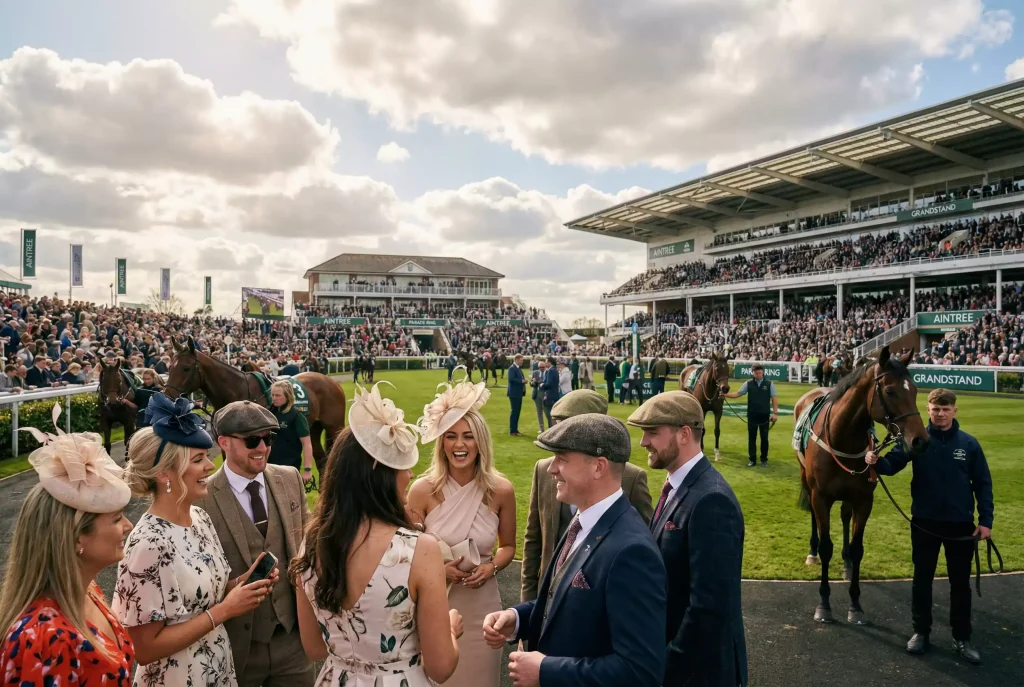
Friday brings the largest single-day crowd of the Festival. Ladies Day combines serious racing with a carnival atmosphere, and the betting rings reflect the mix—sharp punters hunting value alongside racegoers placing their annual flutter. For those willing to look past the fashion and champagne, Friday offers two of the most compelling races of the meeting.
The Melling Chase
The Melling Chase is a two-mile Grade 1 that attracts the fastest chasers in training. Run at genuine pace on Aintree’s Mildmay Course—a sharper, tighter circuit than the Grand National track—it favours horses with both speed and jumping accuracy. There is no margin for error at this trip; a slow jump costs lengths that cannot be recovered.
Cheltenham’s Queen Mother Champion Chase, run three weeks earlier, provides the form benchmark. Some Melling contenders come off Champion Chase victories looking to complete a spring double. Others arrive after honourable defeats, seeking a second chance at a different track. The question for bettors is which horses improve for the switch from Cheltenham’s undulating terrain to Aintree’s flat gallop.
The Melling tends to produce fewer surprises than other Festival races. Proven Grade 1 performers dominate. Long shots struggle to match the pace early and rarely make up ground late. If you are looking for an odds-on shot to anchor an accumulator, the Melling favourite typically runs its race—though it does not always win.
The Topham Chase
The Topham Chase offers a unique betting proposition: a race run over the Grand National fences but at a shorter distance of two miles and five furlongs. This is where course form for Saturday’s main event becomes visible. Horses that handle the Topham’s obstacles—Becher’s Brook, The Chair, the Canal Turn—demonstrate they can cope with Aintree’s unique challenges.
For bettors with one eye on the Grand National, the Topham provides live information. A horse that jumps confidently here, that negotiates the drops and angles without hesitation, gains credibility as a National contender the following year. Conversely, a faller or a laboured performance suggests the National fences may be beyond the horse’s capabilities.
The Topham also stands alone as a betting race. Competitive handicaps over the National fences produce unpredictable results, with experienced Aintree specialists sometimes outperforming classier horses meeting the obstacles for the first time. Previous course form—even from the Becher Chase in December—carries weight here.
Ladies Day Betting Dynamics
Friday’s increased crowds affect market behaviour. Casual money pushes prices on well-known names shorter than their true chances warrant, while lesser-known runners drift despite solid form credentials. Shrewd bettors can exploit this dynamic by identifying value among horses the public overlooks.
The earlier races on Friday—before the Melling and Topham—often produce good-priced winners. Attention focuses on the headline events, leaving the supporting card comparatively underbet. These races are not throwaway contests; they are competitive handicaps with prize money that attracts quality fields.
Ladies Day is the Festival’s social peak. Attendance typically matches or exceeds Saturday, with the fashion element drawing crowds who might not otherwise attend racing. From a betting perspective, the higher footfall means more money in pools—and potentially more uninformed money to exploit.
Saturday: Grand National Day
Saturday builds inexorably toward the 5:15pm start of the Grand National, but the day contains serious racing long before the main event. The Bowl Chase headlines the earlier card, and the supporting races offer betting opportunities for those willing to engage before the National dominates attention.
The Bowl Chase
The Bowl Chase—officially the Betway Bowl—is a three-mile Grade 1 that functions as an alternative Gold Cup. Horses that ran in the Cheltenham Gold Cup three weeks earlier often reappear here, either seeking to confirm their Cheltenham form or to atone for disappointing runs. The race asks similar questions to the Gold Cup: stamina over three miles, the ability to jump accurately under pressure, and the class to prevail at the highest level.
For bettors, the Bowl offers a chance to reassess Gold Cup form. Horses that underperformed at Cheltenham sometimes improve dramatically at Aintree—either because the flatter track suits them or because they needed the Gold Cup run to sharpen their fitness. Horses that won at Cheltenham face the challenge of repeating top-level form on quick turnaround, and not all manage it.
The Bowl field is typically smaller than the Gold Cup—eight to twelve runners rather than fifteen-plus—which makes form analysis more tractable. You can study each contender in detail, assess their Cheltenham runs, and form a view on which will improve or regress at Aintree.
The Build-Up Races
The races preceding the Bowl and the Grand National receive less public attention, which can create value. Handicap hurdles and novice chases fill the early card, and these contests attract competitive fields. Bookmakers price them somewhat generously, aware that most punters are saving their stakes for the National.
If you identify a strong fancy in an early Saturday race, backing it can be profitable—not just in isolation but as a foundation for later bets. A winning start builds the bankroll for National wagers without requiring additional stake money.
Grand National Context
The Grand National itself merits separate, detailed coverage. For the purposes of Festival planning, understand that the National’s 34-runner field and extreme demands make it fundamentally different from the day’s earlier races. Where the Bowl rewards class, the National rewards survival. Different skills, different betting approaches.
Timing Considerations
The Grand National typically goes off around 4:00 pm or 4:15 pm. Earlier races need to complete on schedule for the television window, which means tight turnarounds between contests. If you bet at the course rather than online, queue times for counters and self-service terminals increase sharply in the hour before the National. Place your bets early to avoid missing your prices.
For in-running betting on the supporting card, Saturday’s races offer less scope than Thursday or Friday. The crowd’s attention fragments; in-play markets can move erratically. Pre-race betting is generally the sounder approach on Grand National day.
The Grade 1 Races
The Aintree Festival features three Grade 1 races across its three days—the Aintree Hurdle on Thursday, the Melling Chase on Friday, and the Bowl on Saturday. These are the races where the best horses in training compete at the highest level, and they anchor each day’s betting card.
What Cheltenham Form Tells You
Cheltenham Festival form, run three weeks before Aintree, provides the most relevant benchmark for Grade 1 contenders. Horses that won at Cheltenham arrive with proven class but face the challenge of reproducing peak performance on short turnaround. Horses beaten at Cheltenham may have valid excuses—unsuitable ground, traffic problems, suboptimal trips—that Aintree negates.
The key is understanding how each horse’s Cheltenham run unfolded. A tired fifth in the Champion Hurdle might still indicate a horse capable of winning the Aintree Hurdle if the Cheltenham effort came after a rough race. A comfortable Cheltenham winner might be vulnerable at Aintree if connections misjudge the recovery or if the horse has left its race behind.
Track configuration matters too. Cheltenham’s undulating terrain and testing final hill differ substantially from Aintree’s flat gallop. Some horses act better on one track than the other. Historical patterns—horses that have run at both venues—reveal these preferences.
Pricing Dynamics
Grade 1 races at Aintree are priced efficiently. The betting public knows which horses contested Cheltenham and roughly how to interpret the results. Finding value in these races requires either a contrarian view—believing that consensus opinion is wrong—or identifying information the market has not fully processed, such as a horse’s track preference or a trainer’s deliberate targeting of Aintree rather than Cheltenham.
The most common betting error in Grade 1 races is overvaluing recent Cheltenham winners. The market correctly prices them as short, but not always short enough to reflect the challenge of winning back-to-back Grade 1s on quick turnaround. Horses fresh to the Festival, or those given easier Cheltenham assignments, sometimes offer better value.
Aintree hosts three Grade 1 races across the Festival, excluding the Grand National itself. Each attracts top-class horses and offers betting opportunities against the best in training.
Aintree Hurdle: The Premier Hurdle
The Aintree Hurdle sits three weeks after the Champion Hurdle, which shapes its market. Cheltenham form is directly relevant—runners from the Champion Hurdle, Supreme Novices’ Hurdle, and other Festival hurdles reappear here. Horses who ran well but did not win at Cheltenham often start shorter at Aintree; those who underperformed can drift to value prices.
The trip—two miles four furlongs—suits thorough stayers better than pure speedsters. Horses who struggled to last home over two miles at Cheltenham sometimes find the extra distance advantageous. Conversely, speed horses who dominated at shorter trips may empty late.
Melling Chase: Pure Speed
The Melling is a two-mile chase that rewards class and jumping prowess. The race tends to produce small fields of elite runners, which compresses the odds and reduces each-way value. Betting on the Melling is often a judgement call between two or three quality chasers rather than a search for value in deep handicap.
Form from the Queen Mother Champion Chase at Cheltenham is directly applicable. Ground conditions matter—Aintree’s April going can differ from Cheltenham’s March surface. Check for horses whose Cheltenham running style suggests they will prefer flat track over the hill.
Bowl Chase: Staying Power
The Bowl rewards stamina over speed. Three miles on the flat Mildmay Course favours galloping types who get the trip without fuss. Cheltenham Gold Cup runners dominate the market, but horses from the Ryanair Chase or other three-mile contests also appear.
The Bowl is not the Gold Cup, and treating it as equivalent misses the point. A horse who finished fifth in the Gold Cup might be perfectly suited to the Bowl—less demanding fences, flatter track, smaller field. Look for horses whose Cheltenham effort suggested they will appreciate easier conditions.
Festival Betting Trends
Data from recent Aintree Festivals reveals patterns that inform betting strategy. These trends do not guarantee winners, but they provide a framework for understanding how the meeting tends to unfold.
Favourite Performance
According to Grand National Fans data, favourites won 33 per cent of races at the 2026 Aintree Festival—7 victories from 21 races. That conversion rate exceeds the Grand National’s 20 per cent favourite strike rate and aligns more closely with standard National Hunt racing. Outside the National itself, Festival racing rewards class and form in relatively predictable ways.
This has implications for betting approach. In the Grade 1 races and competitive handicaps across Thursday, Friday, and early Saturday, backing well-fancied runners at sensible prices represents sound strategy. The chaos that characterises the Grand National—large fields, extreme distance, dangerous fences—does not apply to the same degree elsewhere on the card.
Trainer Dominance
Willie Mullins has made Aintree his own. In 2026, his runners won eight races across the Festival and accumulated over £1.5 million in prize money, according to Great British Racing. His dominance extends beyond the headline events to the supporting races, where his second-string runners often outclass British-trained opposition.
For bettors, this creates a straightforward heuristic: when Mullins runs a horse that fits the race conditions, it deserves respect. His strike rate at the Festival justifies support at reasonable prices. The only caution is that the market has absorbed this information—Mullins runners rarely represent value at odds-on—but at anything approaching a fair price, they remain solid selections.
Fresh Horses Versus Festival Veterans
Some trainers bypass Cheltenham to target Aintree, bringing fresh horses to the Festival while rivals recover from three weeks earlier. These fresh runners can outperform on the day because they arrive at peak fitness rather than the tail end of a spring campaign. Identifying which trainers adopt this strategy—and which horses have been deliberately held back—reveals value the market may overlook. Three weeks separate the two meetings, and horses that ran hard at Prestbury Park may not fully recover in time. Watch for fresh legs taking on fatigued rivals.
Multi-Race Betting Strategies
The Festival format—21 races across three days—lends itself to multi-race betting. Accumulators, Lucky 15s, and other combination bets allow punters to leverage smaller stakes into larger potential returns. The key is managing the mathematics responsibly.
Accumulators
A four-fold accumulator across Festival races can produce impressive payouts from modest stakes. If you identify one strong selection per day plus one bonus pick, a £5 four-fold at average odds of 3/1 per leg returns over £300. The challenge is that all four selections must win—a 5-6 per cent probability even at those prices.
Successful accumulator betting requires selectivity. Rather than forcing bets across every race to build accumulators, identify genuine fancies and combine only those. Three strong selections beat four weak ones, even if the headline payout is lower. Quality matters more than quantity.
Lucky 15 and Lucky 31
Lucky 15 (four selections, 15 bets) and Lucky 31 (five selections, 31 bets) structures protect against single-selection failure. If three of your four Lucky 15 picks win, you still collect—whereas a four-fold accumulator with one loser returns nothing. The insurance costs more in total stake, but it converts near-misses into payouts.
These structures suit Festival betting because the card offers enough races to identify four or five genuine fancies without forcing marginal selections. Spread your Lucky 15 across the three days rather than concentrating on a single afternoon—diversification reduces variance.
Bankroll Considerations
Multi-race bets should represent a small percentage of your Festival bankroll. Allocate the majority to single-race win and each-way bets, where your edge is clearest. Treat accumulators and combination bets as entertainment rather than core strategy—enjoyable additions that might pay handsomely but probably will not.
Set a Festival budget before Thursday’s first race. Divide it across the three days with flexibility for opportunities that emerge. Do not bet larger on Saturday because it is Grand National day—the race is harder to win, not easier. Treat each day’s allocation as your session bankroll; when it is gone, stop.
Planning Your Festival Betting
The Festival rewards preparation. Three days of racing, 21 races, hundreds of potential bets—the volume overwhelms without structure. A simple planning framework keeps you focused.
Before the Festival
Study the race cards when they are published. Identify the races where you have strong opinions and the races where you do not. There is no requirement to bet on every race; selective aggression beats scatter-gun coverage.
Set your overall budget and divide it across days. A 50-30-20 split favouring Saturday makes sense for most punters—the Grand National deserves the largest allocation, but Thursday and Friday should not be afterthoughts.
Open accounts with bookmakers offering the best terms for your intended bets. If you plan to bet each-way on outsiders, Betfred’s seven places matter. If you plan to back favourites to win, Betfair Exchange prices matter. Match your bookmaker choice to your strategy.
During the Festival
Review results from earlier races before betting on later ones. Trainer form on the day is a signal—a yard sending out multiple winners is clearly in good form. Ground conditions can change across the meeting; Thursday’s going does not guarantee Saturday’s.
Do not chase losses. If Thursday goes badly, do not inflate Friday’s stakes to recover. Each day is a fresh session. Stick to your allocated budget regardless of cumulative results.
After the Festival
Review your bets honestly. Which decisions were sound but unlucky? Which were poor analysis? The Festival provides a concentrated dataset for improving your approach to future meetings. Learn from it.